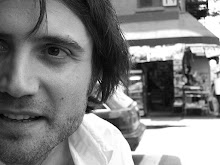
This Saturday (11/1) I'll be the guest on WNYC's Ear to Ear, hosted by David Garland. I'll be interviewed and will choose selections from both Words Project records to be played.
Here is the Ear to Ear website. You can listen to an archived version of the show there after it airs.
Tuesday, October 28, 2008

Friday, October 17, 2008
Sunday, October 12, 2008
daily comfort
We're never as good as we think we are on our good days, nor are we as bad as we think we are when we have a bad day. -Bertrand Russell
Friday, September 26, 2008
the tortoise emerges

One of the biggest reasons I started this blog was to promote new music that I feel might not be getting the attention that it deserves. I previously wrote about my good friend David Doruzka's recent release of poetry settings, which was a staple of my summer listening, and now wish to spotlight saxophonist and composer Rob Mosher's new release with his group Storytime, entitled The Tortoise
, which I so curiously happen to play on.
Until he called me to play one of his open rehearsals at the Brooklyn Lyceum, Rob was unknown to me. He moved here from Toronto in 2004 and somehow our paths had never crossed. Clearly something big has been brewing inside of him since he got here and is probably part of the reason somebody of his talent has existed largely under the radar here. Storytime is a ten-piece ensemble that consists of four wind players (including Rob on soprano saxophone and double reeds), trumpet, french horn, trombone, guitar, bass, and drums. Not quite a big band, but neither a small group, it functions somewhere in the middle, in what some might call chamber-jazz, and offers a myriad of orchestral colors while remaining intimate and quite often subdued.
The tracks on the record are through-composed, and range typically from five to ten minutes in length. None of them ever fall into the typical head, solo, head out format of jazz. Solos emerge out of nowhere, and are brilliantly worked into the ensemble. Despite a beautiful lyrical sense to his melodies, so many of them are indistinct in themselves, small kernels from which everything else emerges. Rather than blow the mystery of the compositional process the way most jazz composers do by giving you the hook upfront and relying on predictable devices (bass ostinatos, odd time signatures, angular melodies, etc.), Rob's pieces unfold slowly, with the patience of somebody much older than Rob. Little motives emerge as the pieces unfold, and appear subtly throughout the instrumentation, tying the pieces together in a very disciplined, yet unexpected way. Much like the great impressionist composers who moved away from large sweeping melodies, Mosher takes the minimum amount of material at squeezes it until every possibility inside of it has been found. Despite the intimidation some might feel at the idea of chamber jazz, a joy permeates this music, even in some of the more tragic sounding moments on the album, and I really believe this record has a rare accessibility to listeners. There are several solos on the record that really knock me out, including one from saxophonist Peter Hess, trombonist Mike Fahie, and two from guitarist Nir Felder, who all soar above the ensemble. Rob makes some beautiful contributions on soprano saxophone (evoking his own brand of Wayne Shorter), but clearly shares the spotlight generously with the other members of the ensemble.
Several humorous miniatures offset the density of this record, and are beautifully worked into the program, offering contrast but always setting the tone for what's to follow. One of my favorite moments is the sudden emergence of a choir singing Latin gibberish on a piece called Sleepless Lullaby. It comes out of nowhere in an otherwise serious piece, but somehow feels totally natural despite its absurdity. None of us had any idea what he had in mind when he handed us a sheet of lyrics on the session and asked us all to sing, and to hear this emerge from something so seemingly silly is quite astonishing.
A CD like The Tortoise is the product of literally thousands of hours of difficult, soul-searching work. It's no wonder so few people know about Rob, as he has clearly had something profound on his mind since getting here, and is one of the most hard-working and dedicated people I know.
Storytime will be having a CD release concert on October 3rd. Here'sthe info:
* Friday, October 3rd, 7:30pm
* Third Street Music, NYC, 235 East 11th Street (near 2nd ave)
* No Admission, Limited Seating, CD's $15
Go to www.robmosher.com to hear clips of the CD and to get information on how to order it.
Tuesday, September 23, 2008
Kucinich on the Wall Street bailout
This just landed in my mailbox this morning. I think it's really important that the Wall Street collapse be seen in a larger context.
Protecting the public interest in any economic "bailout"
Dear Friend,
The U.S. government has been turned into an engine that accelerates the wealth upwards into the hands of a few. The Wall Street bailout, the Iraq War, military spending, tax cuts to the rich, and a for-profit health care system are all about the acceleration of wealth upwards. And now, the American people are about to pay the price of the collapse of the $513 trillion Ponzi scheme of derivatives. Yes, that’s half a quadrillion dollars. Our first trillion dollar compression bandage will hardly stem the hemorrhaging of an unsustainable Ponzi scheme built on debt "de-leverages."
Does anyone seriously think that our public and private debts of some $45 trillion will be paid? That the administration's growth of the federal debt from $5.6 trillion to $9.8 trillion while borrowing another trillion dollars from Social Security has nothing to do with this? Does anyone not see that when we spend nearly $16,000 for every family of four in our society for the military each year that we are heading over the cliff?
This is a debt crisis, not a credit crisis. Just as FDR had to save capitalism after Wall Street excesses, we have to re-invigorate our economy with real - not imaginary - growth. It does not address the never-ending war on the middle class.
The same corporate interests that profited from the closing of U.S. factories, the movement of millions of jobs out of America, the off-shoring of profits, the out-sourcing of workers, the crushing of pension funds, the knocking down of wages, the cancellation of health care benefits, the sub-prime lending are now rushing to Washington to get money to protect themselves.
The double standard is stunning: their profits are their profits, but their losses are our losses.
This bailout will not bring real jobs back to America. It will not bring back jobs that make things. It does not rebuild our schools, streets, neighborhoods, parks or bridges. The major product of this financial economy is now debt. Industrial capitalism has been destroyed.
In the next few days I will push for a plan that includes equity for every American in any taxpayer investment in this so-called bail-out plan. Since the bailout will cost each and every American about $2,300, I have proposed the creation of a United States Mutual Trust Fund, which will take control of $700 billion in stock assets, convert those assets to shares, and distribute $2,300 worth of shares to new individual savings accounts in the name of each and every American.
I will also insist that all of the following issues be considered in whatever Congress passes:
1. Reinstatement of the provisions of Glass-Steagall, which forbade speculation
2. Re-regulation of the finance, insurance, and real estate industries
3. Accountability on the part of those who took the companies down:
a) resignations of management
b) givebacks of executive compensation packages
c) limitations on executive compensation
d) admission by CEO's of what went wrong and how, prior to any government bailout
4. Demands for transparencey
a) with respect to analyzing the transactions which took the companies down
b) with respect to Treasury's dealings with the companies pre and post-bailout
5. An equity position for the taxpayers
a) some form of ownership of assets
6. Some credible formula for evaluating the price of the assets that the government is buying.
7. A sunset clause on the legislation
8. Full public disclosure by members of Congress of assets held, with possible conflicts put in blind trust.
9. A ban on political campaign contributions from officers of corporations receiving bailouts
10. A requirement that 2008 cycle candidates return political contributions to officers and representatives of corporations receiving bailouts
And, most importantly, some mechanism for direct assistance to homeowners saddled with unreasonable or unmanageable mortgages, as well as protection for renters who have lived up to their obligation but fall victim to financial tragedy when the property they live in undergoes foreclosure.
These are just some thoughts on the run. You will hear more from me tomorrow.
Dennis J Kucinich
www.Kucinich.us
216-252-9000 877-933-6647
Wednesday, September 17, 2008
Inadvertent Songs on WNYC's New Sounds
Words Project II was featured recently on the WNYC program New Sounds,hosted by Jon Schaefer. The program was called Inadvertant Songs and also featured Gabriel Kahane, who has been a huge influence in some of my more adventurous text settings over the past two years. As you can imagine, the program is about composers using unlikely texts in their music, and featured my setting of Caitlin Upton's grand moment in the 2006 Miss Teen USA pageant.
To listen to the program, which features some great new music, go here.
To listen to the program, which features some great new music, go here.
Subscribe to:
Posts (Atom)


 Posts